
Finalit Labs
Forecasting outcomes before they happen.
We study whether outcomes can be forecast before they happen, measured against what follows, and improved by the evidence that accumulates. Our research begins with communication.
Technical Report No. 1October 2026
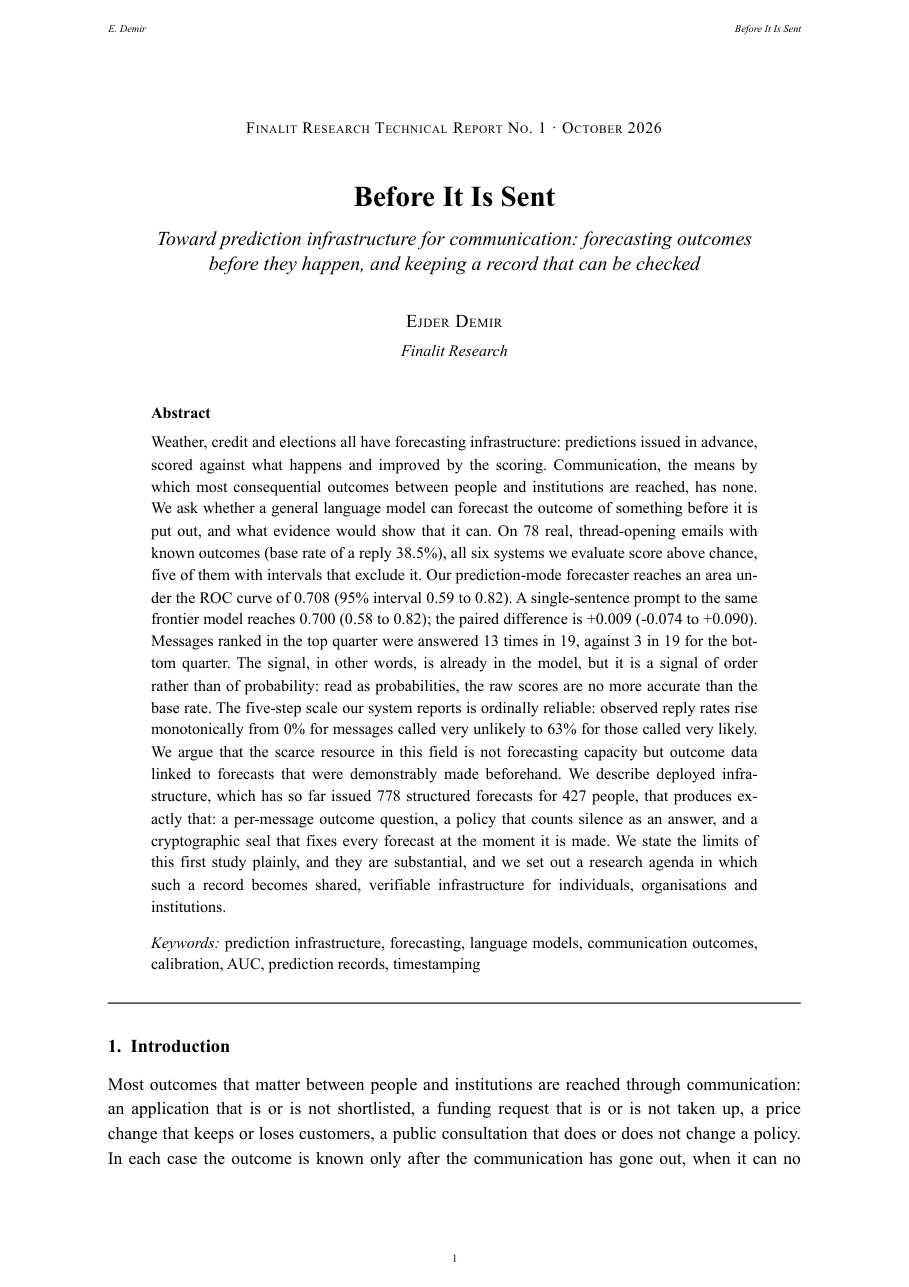
Before It Is Sent
Toward prediction infrastructure for communication: forecasting outcomes before they happen, and keeping a record that can be checked.
Ejder Demir
What we found
13 vs 3
Top-ranked messages were answered far more often.
Of the 19 messages ranked highest, 13 were answered. Of the 19 ranked lowest, 3. This shows the ranking carries information about outcomes, not that acting on a forecast changes them.
78 real emails, one sender
0.708
Better than chance, and significant.
Area under the ROC curve, 95% interval 0.59 to 0.82. A one-line prompt to the same frontier model reaches 0.700, so the method is not better than the model. The signal is in the model. The record is not.
Labels shuffled 10,000 times, p = 0.001
0 → 63%
Reply rates rose at every step of the scale.
From very unlikely to very likely, each step was answered more often than the one below it. Two steps hold only three messages each, so the order there is suggestive, not established.
See Fig. 3 below
No skill
As probabilities, the scores add nothing.
Read as percentages, model scores are no more accurate than quoting the base rate. Models rank well and price badly, so Finalit reports steps, never percentages, until outcomes have earned them.
Brier skill +0.03 and −0.08
Fig. 3Observed reply rate by step
0%
24%
33%
44%
63%
Very unlikely
0 of 3
Unlikely
5 of 21
Even
1 of 3
Likely
19 of 43
Very likely
5 of 8
The record
Every forecast is sealed the moment it is made.
A forecast checked after the fact is only worth something if it demonstrably existed, unchanged, before the outcome was known.
Since 11 October 2026, every forecast Finalit makes is fingerprinted with SHA-256 at the moment it is logged, on server time, and what it predicted can no longer be changed through the product. We plan to publish a daily fingerprint outside our control, so anyone can verify a forecast predates its outcome without trusting us.
01then
Forecast
Event, step, frame
02then
Seal
SHA-256, server time
03then
Day root
Published daily. Planned
04last
Outcome
Scored only against an earlier seal
What the evidence shows
A preliminary link, on one sender's email, between how forecasts rank messages and whether they were answered.
What we have built
A way to commit to every forecast before its outcome and evaluate it afterwards. Sealing is live; independent verification is planned.
What we are pursuing
Forecasting that holds across people, kinds of communication and outcomes, and improves as outcomes accumulate.
Research agenda
From individual forecasts to prediction infrastructure.
01
Forecast
Name a measurable outcome for the specific item and register a forecast before it is known.
In production
02
Verify
Seal every forecast when it is made, then publish daily roots outside our control so anyone can check it predates its outcome.
Sealing live. Publishing planned
03
Learn
Score forecasts against resolved outcomes and turn ordered steps into earned probabilities, context by context.
Outcomes collecting
04
Scale
Extend shared records from people to teams, organisations and institutions.
Future work
Open questions
- Q1Does the forecast hold for new people, whose messages played no part in building it?
- Q2Does it hold for other kinds of communication, and other outcomes than a reply?
- Q3Does it hold across models, so that the record, not any one model, carries the result?
- Q4Do accumulated outcomes make forecasts better than a model achieves without them?
The fourth is the one that matters most. A sealed record is infrastructure; showing that it makes forecasts better is what our next report is designed to test, prospectively and under a protocol declared in advance.
Publications
Oct 2026
Before It Is Sent
Technical Report No. 1. Ejder Demir.
Read →
Oct 2026
Sealing every forecast
Methods note. Finalit Research.
Read →
Oct 2026
How we test a change to the forecaster
Methods note. Finalit Research.
Read →
Every number on this page comes from our reports, with its sample and interval. We publish the limits of each study alongside its results: the first rests on 78 emails from one sender, and says so.